Growing, Harvesting, & Preserving Your Own Tomatoes

Introduction

Who doesn’t enjoy eating a fresh tomato? When you grow them yourself, they are so much better than the hothouse ones from the grocery.

Tomatoes can be a hard thing to get to take off at first. But when you have fresh tomatoes of salsa in the summer or tomato juice to make chili in the winter, it is so rewarding! It is also a good time to remember to give Thanks to Yehovah for all things he has given you.

Planting

To start your tomatoes you will want to start them in late winter, in either your potting shed or greenhouse. If you don’t have either of those things, you can always start them in your house.

First, begin by having your trays and potting soil on hand. Really broke down compost makes good potting soil!

Fill your tray(s) with your soil and push it down until it is about 3/4” from the top of the tray. Water the soil lightly. This will make the seed not go down too deep when you water again after you have planted the seeds. Why does that matter? Because if the seeds go down too far, the seed will not sprout; it will rot.

Now, put 1 seed in each cell and cover them by topping off each cell with more soil. Make sure to keep the soil moist by watering them. Keep them as much in direct sunlight as possible. Within 7-14 days, they should begin to sprout, depending on how much sunlight they are able to get. Remember, if you are planting more than one variety, to put markers so you know which varieties are which.

Note: At this point, they may become spindly. If they are still short and just a little spindly, they should end up being fine. If they are VERY spindly, so that they are weak and snapping, don’t worry! They can still be saved.

Very carefully, pull them up out of their cell with your fingers. Do it one sprout at a time so that you don’t end up with a mess. Fill your cell with dirt and make a hole in the dirt by pressing down your finger about an inch and a quarter. Now put your spindly little sprout down into the hole and fill the little hole back in. Your objective will be to have the spindly part covered in dirt up to the leaves.

Taking Care of the Young Plants

Keep a close eye on your sprouts, and make sure that they maintain a good green color. You do not want them to begin turning a pale yellow color. If they start to turn a pale yellow color you need to act quickly so that you do not lose your plants. Put broke down compost around them to ‘feed’ them, because they turn pale from not getting the nutrients they need. This should turn them around pretty quickly.

If it starts to warm outside, into the 50F range or above, you need to bring them outside in the daytime as much as possible to make sure they get as much sunlight as possible. But be sure to bring them in when it is cold, you don’t want them getting frosted on!

Transplanting

About 35-40 days after planting, your plants should be too big for their cells. It is time to transplant them.

We transplant ours from their cells right into 9 oz cups. You should be able to find this size cup at pretty much any store. Either plastic or thick paper work well. You want to make a little hole in the bottom of each cup to make sure the excess water can drain out.

Fill your cups a little over 1/4 way full of potting soil/compost and put your plant in. Then fill the rest of the cup with soil until it is all the way up to the leaves. When finished, water them. Keep in mind not to let your plants be in too cold of temperatures or get frosted on!

Planting Outside

The timing on planting outside is all going to depend on where you live. Look up the last frost date for your area. Sometimes it will frost after the ‘last frost date’ but it will give you a pretty good idea of when it is safe to move your plants outside for good. We usually plant our tomatoes outside within the week after the last frost date for our area.

This gives us a pretty good chance of having some really early tomatoes.

To plant, just dig a hole in the ground, put compost, water, and your plant all in the hole and cover with dirt. We plant ours between about 4 rows of corn. This helps keep them shaded and prevent sun-scalding from happening to the tomatoes when the fruit begins to come on them in a few months.

Keep your plants moist and watered until they are established.

If they start looking pale, or you don’t see them beginning to bloom, or even not too many blooms, compost your plants. You should also put a small handful of Epsom salt in a gallon of water and put it on your plants. This brings up the magnesium and help your plant have more (and more productive) blooms.

When your plants get bigger, you may notice they start to cover your walkways and take over the garden. It’s time to tie them up!

Set posts on each end and in the center of your rows as close as they need to be to keep a straight line and not have the plants sag. Run your string post to post, tying up your plants as you go. The end result should look something like this:
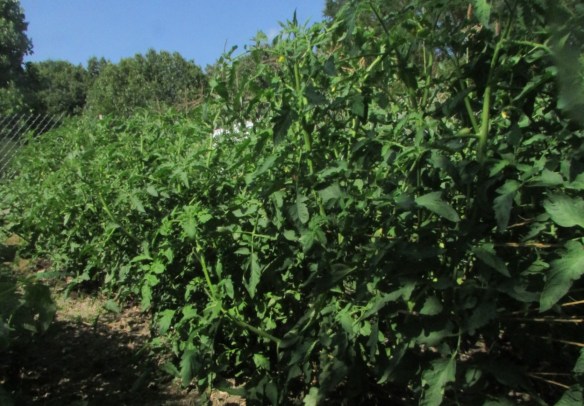
Keeping your plants tied up will help to prevent blight. More tomato related issues, and how to deal with them , to come in another post soon!

Harvesting

This is one of the things we all look forward to every year! Who doesn’t look forward to eating a fresh tomato? And harvesting tomatoes is simple; all you have to do is just pick them off your plants!

Be sure to give thanks to our Heavenly Father for his wonderful blessings. And remember to bless others with the first-fruits of all your increase! (Prov. 3:9)

Preserving (Canning) Tomato Juice

There are many different ways to preserve tomatoes. But we are going to focus on canning them as juice today.

Juice

Wash your tomatoes and cut them in quarters. Put a pot on to cook down and keep it stirred. If they are not already juicy enough and, even when stirred, seem to want to burn easily, you can add a little water if need be.

When your tomatoes have cooked down (you’ll be able to tell as they will just seem like ‘mush’), run them through your food mill, the same as you do applesauce. (see post here)

When you have finished this process, put your jars into the oven on ‘warm’ setting, or the lowest your stove will go (most go down to 170F and this is suitable)

We are going to do what you call the “water bath” method.

Fill your canner half full of water and turn your burner on.

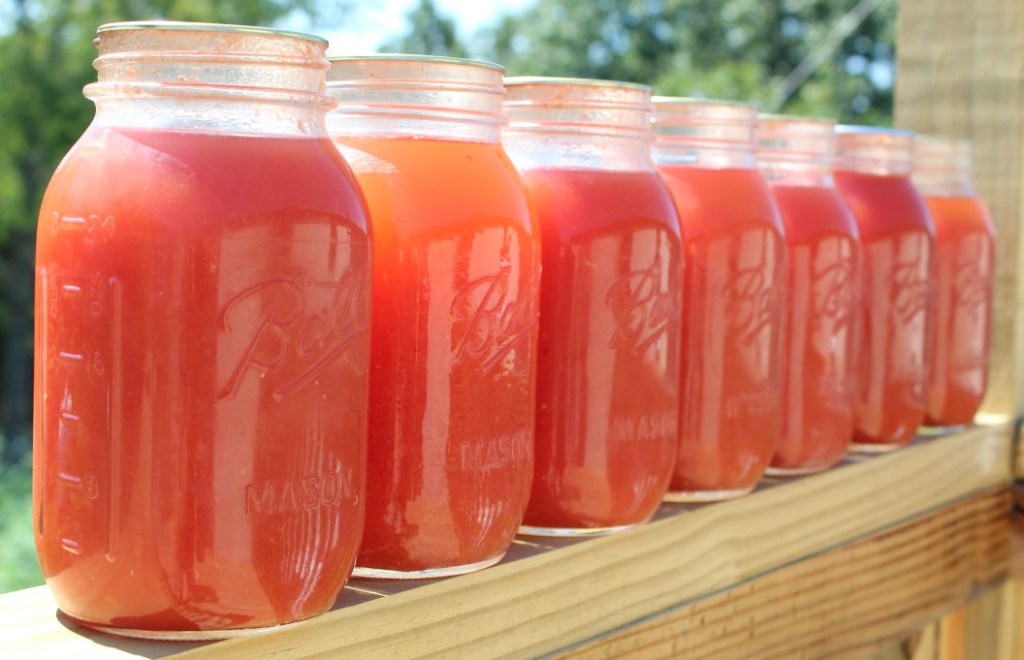
Now you should have hot juice, hot jars, and a hot canner ready to go. Ladle that hot juice into your jars and wipe the rims clean. Then, place your lids on your jars and screw on the rings tightly. Place in your canner and put on the lid on, but do NOT lock it on. When your water starts to boil, set your timer for 35 minutes.

The next step is taking them out of the water. Start by placing a towel on your countertop and then put your jars on top of the towel, using a jar lifter to keep from getting burnt. A jar lifter is pictured below:

Let your jars sit on your counter for 12 hours. Check seals and store.

The reason you want to check the seals is to make sure they are all secure before you store them.

You check the seals by tapping the jar lids with one finger. As you tap them, listen for a jar that sounds different than the rest of them. It will usually make a hollow sound.

If you find a jar that hasn’t sealed, put it in the fridge and use it soon. If you are planning more canning, you can try to can it again. Make sure there are no nicks in the top of jar and a good lid on it.
Processing Pear Slices

Harvest is a joyful season. God says it is good for us to enjoy the fruit of our labor.

Behold that which I have seen: it is good and comely for one to eat and to drink, and to enjoy the good of all his labour that he taketh under the sun all the days of his life, which God giveth him: for it is his portion.

Ecc. 5:18

Makes 7 quarts, or 14 pints

You want to start by washing your pears, getting off any dirt that can put bacteria into your jar and keep it from sealing.

After you pears are washed, peel them. Cut into halves or quarters to remove the core. Then cut into your desired slice width, like you would apples.

Take a stock pot, and put it on the stove with 2 gallons of water and 2 cups of sugar. Then fill the rest of your stock pot with the sliced pears. Let cook on medium heat for 2 minutes, you don’t want them to turn into mush!

Canning Preparation:

Fill your canner half way with water, and turn on. Put your empty jars in your oven on ‘warm’. If your oven doesn’t have a ‘warm’ setting, just put it on the lowest setting it has.

When everything is hot/warm, you are ready for the next step.

Fill your hot jars with the hot slices, leaving an inch of head space in the top of your jar. Pack pear slices tightly into jar. Put a butter knife down the insides of your jar (between the glass and the pears) to let out any air bubbles in the jar. Wipe your rims clean with a rag or paper towel to remove any food fragments. If you don’t do this, it can prevent your lids from sealing tightly to your jar.

Put on your pre-warmed lids and screw on your rings tightly. Put your jars into your warm water in your canner, with a jar lifter, pictured below.

Canning/Water Bathing

After all the jars are in the canner, you want your water to be one inch above the jars for water bathing. Turn on high. When the water starts to boil, set your timer for 25 minutes for quart jars or 20 minutes for pint jars. Turn stove to medium heat. When timer goes off, turn heat off, and let canner sit for 5 minutes. Then, carefully take out your jars with a jar lifter and set them on a towel on your countertop to cool. If your bands are loose, do not tighten them..

Let cool for 12 hours. Check seals and store.

The reason you want to check the seals is to make sure they are all secure before you store them.

You check the seals by tapping the jar lids with one finger. As you tap them, listen for a jar that sounds different than the rest of them. It will usually make a hollow sound.

If you find a jar that hasn’t sealed, put it in the fridge and use it soon. If you are planning more canning, you can try to can it again. Make sure there are no nicks in the top of jar and a good lid on it.

Blessed is every one that feareth Yehovah; that walketh in his ways. For thou shalt eat the labour of thine hands: happy shalt thou be, and it shall be well with thee.

Ps. 128:1-2

How to Make and Can Apple Pie Filling

Start by washing your apples. Once that is done, peel, cut, core and slice.

Put these slices into a large stockpot. If your apples are really dry, you need to add about a quart or so of water to a very large stockpot full. If your apples are very juicy, you need little to no water. You will have to gauge it by the juiciness of your apples, so that they do not burn. Stir continually.

Shut them off when they are mostly cooked, but still a little hard.

To a large stockpot, add:

4 cups Brown Sugar

3 Tbsp Lemon Juice (optional)

2 tsp. Cinnamon

1 tsp. Nutmeg

Warm water if very thick until it reaches desired consistency

Canning Preparation:

Fill your canner half way with water, and turn on. Put your empty jars in your oven on ‘warm’. If your oven doesn’t have a ‘warm’ setting, just put it on the lowest setting it has.

When everything is hot/warm, you are ready for the next step.

Fill your hot jars with the hot filling, leaving an inch of head space in the top of your jar. Pack filling tightly into jar. Put a butter knife down the insides of your jar (between the glass and the sauce) to let out any air bubbles in the jar/filling. Wipe your rims clean with a rag or paper towel to remove any filling. If you don’t do this, it can prevent your lids from sealing tightly to your jar.

Put on your pre-warmed lids and screw on your rings tightly. Put your jars into your warm water in your canner, with a jar lifter, pictured below.

Canning/Water Bathing

When all the jars are in the canner, you want there to be about 1” of water covering the top of all jars. Put your canner lid on, but do not lock it. Watch for when water starts to boil. When it does, turn heat to medium, and set your timer for 25 minutes.

When timer goes off, shut off canner. Let sit for 5 minutes.

Place a towel on your counter. Take your jar lifter, and carefully remove your jars from the hot canner and onto your towel. Do not tighten your rings if they loosen.

Let cool for 12 hours. Check seals and store.

The reason you want to check the seals is to make sure they are all secure before you store them.

You check the seals by tapping the jar lids with one finger. As you tap them, listen for a jar that sounds different than the rest of them. It will usually make a hollow sound.

If you find a jar that hasn’t sealed, put it in the fridge and use it soon. If you are planning more canning, you can try to can it again. Make sure there are no nicks in the top of jar and a good lid on it.

Processing Applesauce & Apple Butter

Start by washing your apples. Once that is done, cut into quarters; skins, seeds and all.

Put these quarters into a large stockpot. If your apples are really dry, you need to add about a gallon of water to a very large stockpot full. If your apples are very juicy, you need little to no water. You will have to gauge it by the juiciness of your apples, so that they do not burn.

Put your stockpot on the stove, start, and stir often; about every few minutes.

After the apples are cooked down, while it is still hot, run all your hot, mushy apples through your food mill. The result will be applesauce!

Two Types of Food mills (we prefer the one pictured on the right)

Apple Butter (skip this part if you just want to can your sauce)

To fill one canner with quart jars:

28 cups applesauce (or 7 quart jars)

4 cups sugar

2 tsp cinnamon

1/2 tsp ground cloves

Put into oven or roaster pan, and cook at 350F and cook it down for 5-9 hours. You want it to be thick so that when you stir it with a spoon, it has the consistency of jelly. You will have to watch your particular batch to see how long that takes.

Prepping for canning

Fill your canner half way with water, and turn on. Put your empty jars in your oven on ‘warm’. If your oven doesn’t have a ‘warm’ setting, just put it on the lowest setting it has.

When everything is hot/warm, you are ready for the next step.

Fill your hot jars with the hot applesauce, leaving an inch of head space in the top of your jar. Put a butter knife down the insides of your jar (between the glass and the sauce) to let out any air bubbles in the jar/sauce. Wipe your rims clean with a rag or paper towel to remove any sauce. If you don’t do this, it can prevent your lids from sealing tightly to your jar.

Put on your pre-warmed lids and screw on your rings tightly. Put your jars into your warm water in your canner, with a jar lifter, pictured below.

Water Bathing

After all the jars are in the canner, you want your water to be one inch above the jars for water bathing. Turn on high. When the water starts to boil, set your timer for 20 minutes for quart jars or 15 minutes for pint jars. Turn stove to medium heat. When timer goes off, turn heat off, and let canner sit for 5 minutes. Then, carefully take out your jars with a jar lifter and set them on a towel on your countertop to cool. If your bands are loose, do not tighten them.

Cool for 12 hours. Check seals and store.

The reason you want to check the seals is to make sure they are all secure before you store them.

You check the seals by tapping the jar lids with one finger. As you tap them, listen for a jar that sounds different than the rest of them. It will usually make a hollow sound.

If you find a jar that hasn’t sealed, put it in the fridge and use it soon. If you are planning more canning, you can try to can it again. Make sure there are no nicks in the top of jar and a good lid on it.

How to Start, Grow, Harvest and Preserve Your Own Sweet Potatoes

Starting Your Slips

In mid-winter take your best sweet potato and put it in a quart canning jar filled with water. (DO NOT CUT YOUR POTATO!)

Don’t have a sweet potato you grew? That’s okay, just get a couple from the store.

Set your canning jar in the window sill. Change the water every few days, or when the water begins to stink.

After about 3 weeks, your sweet potato will start to sprout. Once your sprouts/slips are 3”-4” tall and leafed out, snip off the slips and put them in a pint jar of water.

Once they are in the jar of water, they will start growing their own roots.

If the slip or root growing process seems to be taking awhile, adding some compost to the water helps to speed up the growth.

Once your slips have grown roots that are 2-4”, they are ready to transplant.

We have found that it works best to plant them in a pot of dirt that is VERY wet.

This prevents them from going into shock, by just going straight from the jar of water, into the garden.

You want to keep them in your pot of wet dirt for at least 5-7 days, longer is okay.

If it is still cold outside, keep this pot indoors in a window sill as well.

Planting Sweet Potatoes Outside

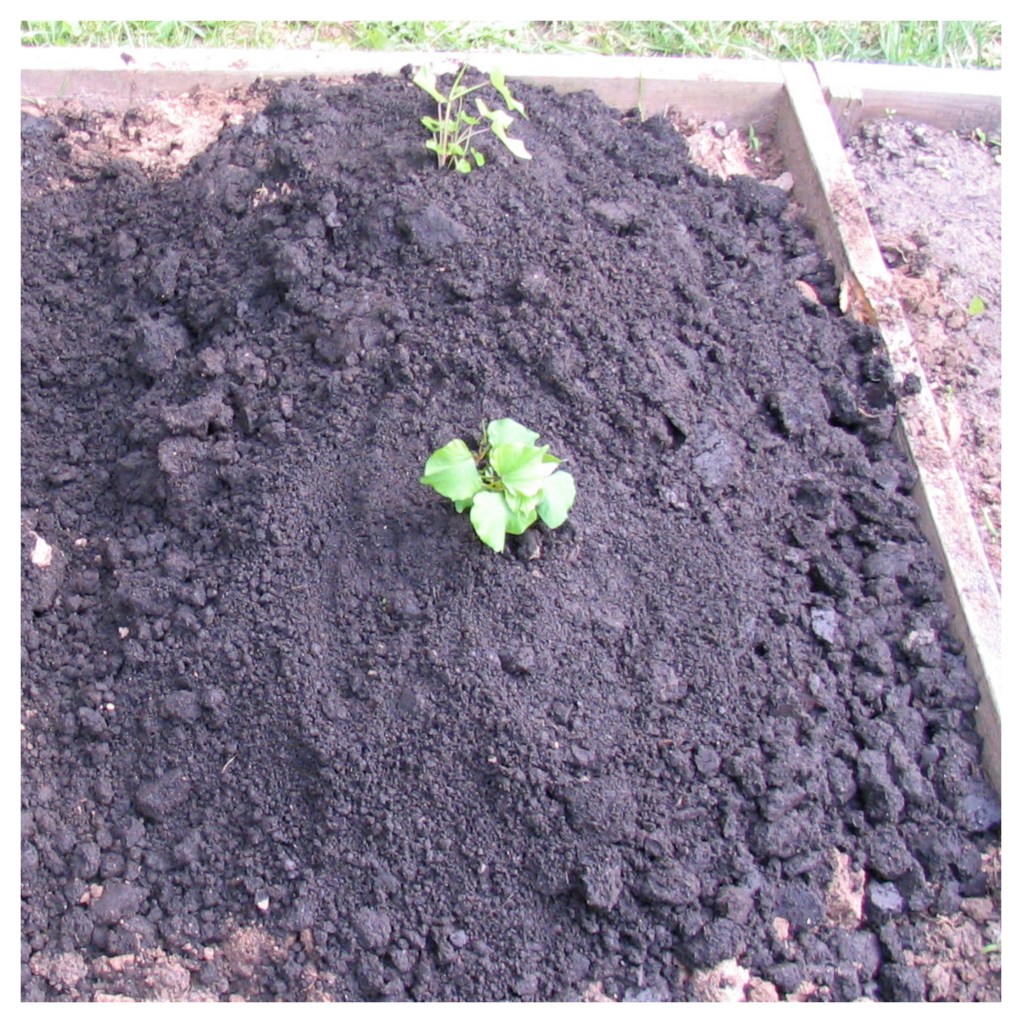
You want to plant your slips outside after your last frost date. With your hoe, make small hills about 1′ around and 1′ high.

With your hoe handle, make a 4” deep hole in the center of your hill. Take your slips (we like to do 3-4 per hill), spread out the roots and cover with dirt. Then top your hill with compost.

Watering

Water WELL everyday until plants are established. This is VERY IMPORTANT!

Once established water a couple times a week (unless it rains, of course).

Pests

There are many garden pests who will attack your potato vines. These include sweet potato weevils, sweet potato beetles, wireworms, flea beetles, and blister beetles.

If any pests attack your sweet potato plant, spray Neem oil (organic spray) 1-2x per week, or more depending on how bad the bugs are and how much damage they are causing.

If it is blister beetles that are eating your sweet potato plants, remove them WITH GLOVES (THEY DO GIVE BLISTERS) into soapy water. You will have to be on top of it checking daily, or several times daily, until they are gone. Otherwise they WILL destroy your plants.

Feeding the Plant

If your sweet potato leaves are looking a little yellow, or just not growing well, you need to feed the plant. You need to add compost around the hill and plant. It is also a good idea to put hay or mulch around the hills in the dry season, to keep the moisture in.

When to Harvest

Harvesting is an exciting time, and a time to be thankful to God for what He has blessed us with. Ecc. 3:13 says, “Every man should eat and drink, and enjoy the good of all his labour, it is the gift of God.”

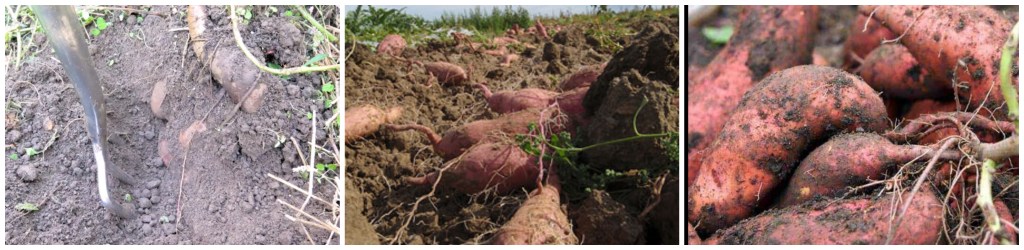
Before your first frost date (it is alright if the plants get frosted on, just make sure they don’t get frosted on repeatedly.)

Take a potato fork and dig up the hills, being careful not to dig the fork into the potatoes themselves.

Carefully brush off any dirt with a soft bristled brush, making sure you do not remove or scratch the skins.

Storing

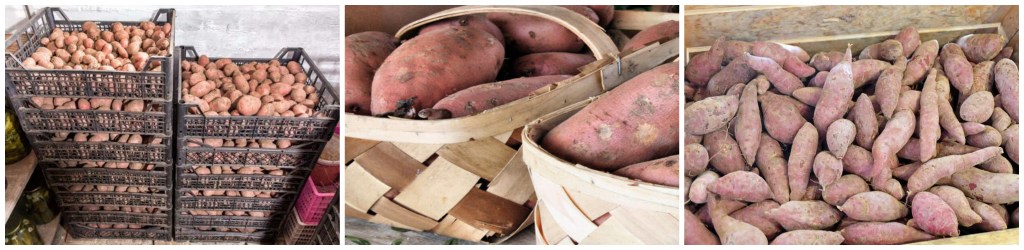
Store them in a cool, dark place to let them cure for about two weeks. You can begin using them after this time; but they longer they cure, the sweeter they will be!

Preserving

If your sweet potatoes are not keeping well, for whatever reason, you will need to can them.

Prov. 12:27 says, “the substance of a diligent man is precious.” We don’t want what is ‘precious’ to us to go to waste!

Canning

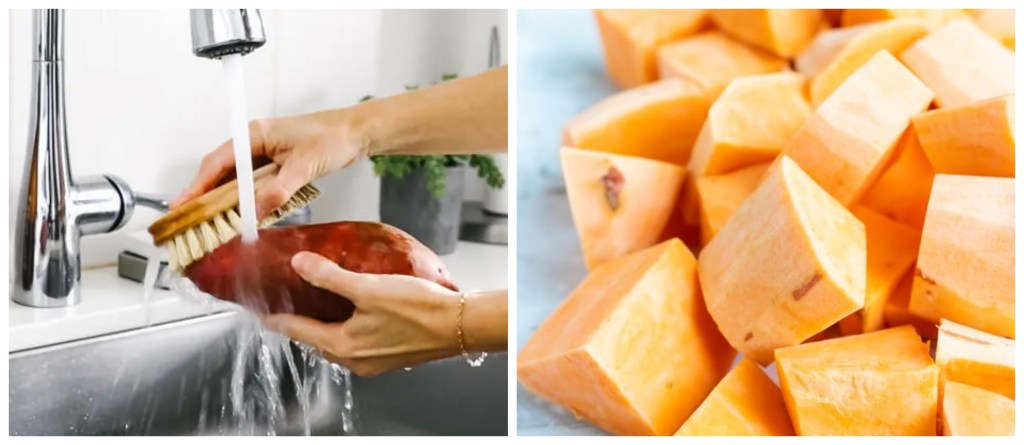
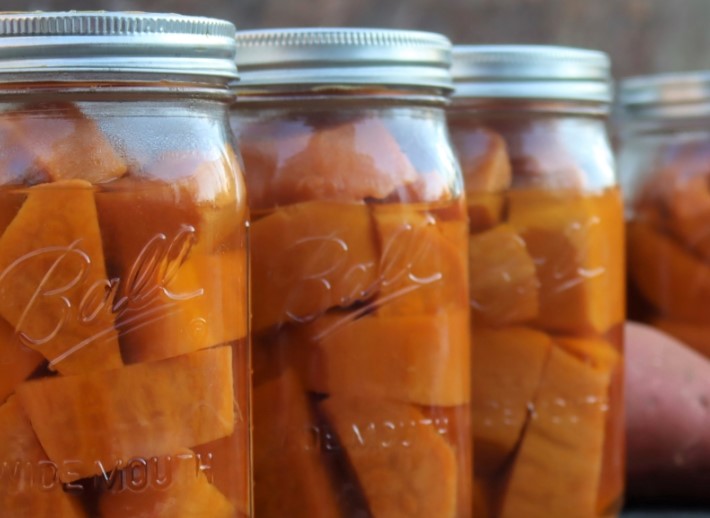
You begin this process by washing the potatoes well. Cut them into bigger chunks, (you can peel now, or after the boil) put them into water and bring to a boil. Let them boil for about 10 minutes, then remove from heat. Do not strain the water out of the potatoes; you are going to use it in a moment.

Take the potatoes out of the water with a slotted spoon. If you did not peel them beforehand, you can slip them off now. Fill the jars with the peeled potato chunks.

Ladle the water you boiled them in over the potato chunks, leaving 1” head space between the water and lid. Put your lids and rings on the jars tightly.

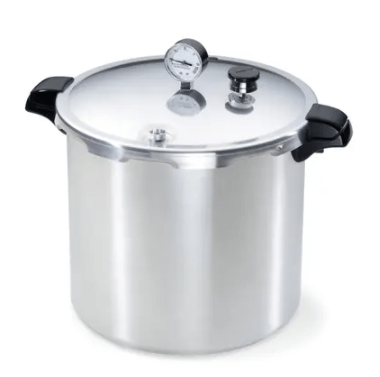
Place your jars in the canner with hot water, and slide the lid into ‘lock’ position. Once steam starts to come out of the vent pipe, set your timer for 10 minutes.

When your timer goes off, and your ten minutes in up, put the weight on, and let the pressure build up to 10psi.

If you used pint jars, keep at 10psi for an hour and 5 minutes.

If you used quart jars, keep at 10psi for an hour and a half.

When the time is up, let cool as the pressure comes out. When all the pressure is out (your psi is back to zero) Remove your jars from the canner. DO NOT re-tighten bands if they came loose.

Allow to continue cooling for about 12 hours or so.

Check your seals (use any if they didn’t seal, soon) and store.

DON’T FORGET! Save some of your potatoes to start your slips in mid winter! Then you’ll never have to buy slips from a greenhouse again! 🙂

What to do with Canned Sweet Potatoes?

You can heat them up straight from the jar, mash, and put cinnamon and butter on them, or you can add them to soup.

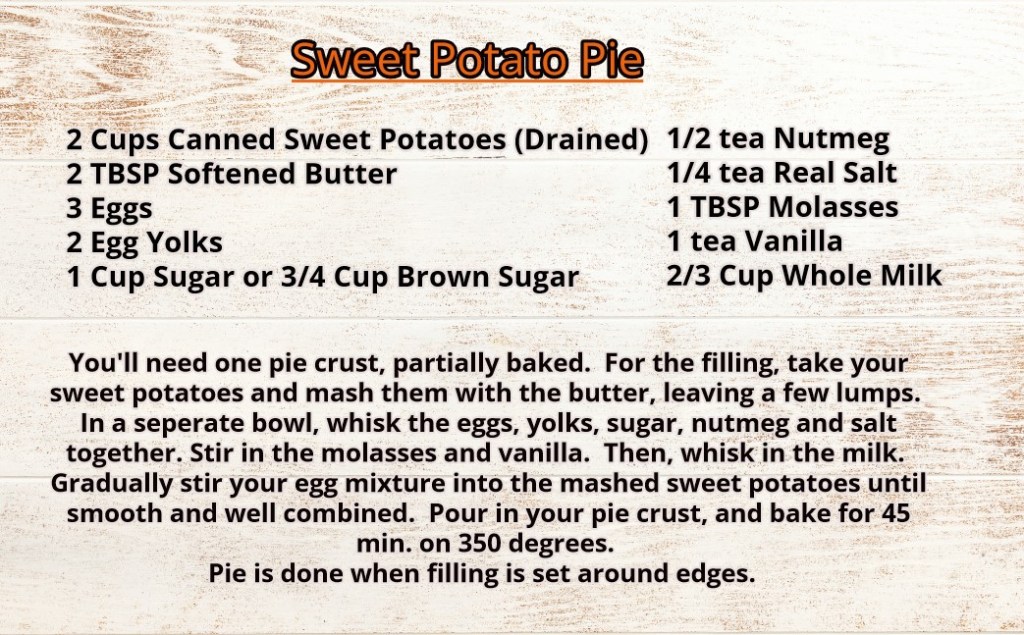
Have you ever had Sweet Potato Pie? If you like Pumpkin Pie, Sweet Potato Pie is just as good. Some in our family would say EVEN BETTER!

Here is our family’s favorite recipe:

Beets

Planting, Harvesting, Canning, and Saving Seeds

Planting Beets in Trays

First you will need to have your planting tray ready. Pour your soil on your tray. Push soil into the cells of your tray. Sprinkle with water. When you are finished, put 4 to 5 beet seeds in each cell. Put your soil on top. Make sure your soil is not too deep, or your seedlings will not come up. Water again, and water your seeds each day. They should sprout up in about 7 to 14 days after planting.

The reason why we plant them like this is because it saves on space and it allows the root to get bigger and they grow better together.

Note: If the seedlings get long and spindly, just replant them deeper.

In 2 to 3 weeks you should be able to plant them outside. Make sure it is after the first frost, so that they do not get killed by frost. When you plant them outside, give them space to get big, about 6-8 inches apart. Keep watered, in the dry season.

Harvesting your Beets

Honor Yehovah with thy substance, with the first fruits of all thine increase. Proverbs 3:9

We seek to obey the Father and give our first fruits away in order to obey His word. We have seen His faithfulness in abundantly blessing, our harvest, since obeying the Scriptures, just like in all areas of life where we seek to obey.

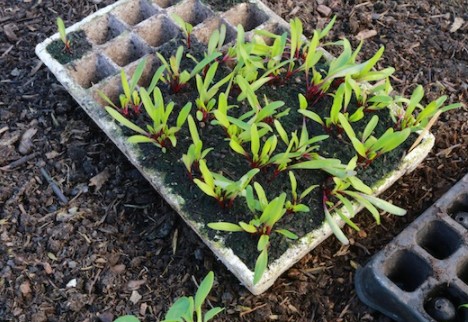
When your beets look like the picture below, pull them up, taking the biggest out so that the smaller ones can continue to grow. Cut off the tops/greens of your beets. You can saute the greens, see recipe here, or compost them.

A word of caution: If you are prone to kidney stones be aware that many stones are formed from an anti-nutritent called oxalate. Spinach contains the highest amount of oxalate, however beets contain some as well. To help bind the oxalate, you can eat something with calcium, beet and cottage cheese is good!

Preparing your beets for canning

Put a pot of water on to boil. Keep the the long tap root on the beet for now. Wash your beets in the sink, and when your water comes to a boil, put your beets in the boiling water for 10 to 20 minutes, or until the beets skins’ are coming off and you can stick your knife in the beet and it is soft.

When your beets are ready to cut, carefully take the beets out of the pot of boiling water and put them on a cookie sheet. Let cool. When cooled, cut off the tap root, take the skins off, and slice your beets into whatever size you want.

Canning your Beets

Some folks like pickled beets. Here is a link to our Pickled Beets Post.

The instructions below are for canning beets, without pickling.

Get your presser canner and put it on the stove. Fill with water 1/4 to 1/2 full, and turn canner on low. You are going to need to turn your oven on warm, or the lowest setting it will go to heat your jars. The reason you need to have your jars hot, is so that when you put your hot beets and boiling water in, your jar won’t break.

When your jars and canners’ water are hot, and beets are sliced, ladle your beets and hot boiling water into the jar, leaving 1 inch head space at the top.

Remove air bubbles by sliding a knife down the sides of the jar. Wipe jar rim and put lid and ring on tight.

Turn your burner on high. DO NOT USE A FLAT TOP ELECTRIC RANGE IT WILL CRACK THE TOP.

DO NOT LEAVE YOUR CANNER!

Once steam starts coming out of your canner’s vent pipe, set the timer for 10 minutes.

When the timer goes off, place your weight on your vent pipe. The pressure will start building. When pressure reaches 10psi turn your canner on low to keep it there. Set the timer for 35 minutes for quarts, and 30 minutes for pints.

MAKE SURE TO KEEP YOUR CANNER AT 10psi. You may have to shut off your burner and turn it back on.

When the timer goes off, turn off your burner and let your canner cool.

CAUTION! DO NOT REMOVE YOUR CANNER LID OR WEIGHT UNTIL YOUR CANNER HAS COOLED AND RELEASED THE PRESSURE. YOUR REGULATOR WILL BE AT 0, WHERE IT STARTED.

Once the pressure has released from your canner remove the weight from the lid. Make sure you put it somewhere you won’t lose it. Open the lid turning it away from you, so you don’t get steam burnt.

Place a towel on the counter, and carefully lift your jars out of the canner with a jar lifter, and place them on the towel. Some of your jars will seal after you remove them from the canner.

CAUTION! DO NOT PUT ANYTHING ON TOP OF YOUR JARS. It will cause them to unseal.

At this point, we used to cover our jars with a towel. However, we’ve since learned that you want the jars to come out of the canner and be exposed to the quick temperature change in order to seal.

Once your jars are cooled, check to make sure they all sealed (gently tap the lid and listen to the sound, if one sounds hollow and clicks when tapped it’s not sealed) if they are sealed, remove the rings and store the jars.

Saving Beet Seeds

If you want to save your seeds make sure you are buying a heirloom variety. You can’t save the seeds from a hybrid and it come back the same thing. The package will usually say if they are heirloom. Some examples of heirloom beets are Detroit Dark Red, Sangria, Sweetheart, Ruby Queen, to name a few.

A hybrid is a way the government has used to get people to rely on them for their seeds. Now many people are on food stamps. They have gotten to where they don’t grow their own food, and don’t know how to. We hope reading this post will encourage and teach you how to.

Step one, do not harvest some of the beets that you planted. Keep them in the ground over the winter. They should start greening up on the spring. As they grow, they will start getting flowers on them, like the picture below.

Beet “spikes”

By late summer/ early fall you should see the flowers die, and the seeds appear. You’ll recognize them by the seed you planted in the ground. The seed will dry out on the plant turn brown/tan, and you can then harvest the seeds. Cut the “spikes” and put them in a brown paper bag to finish drying for a couple weeks.

Store your seeds in a cool dry place for the winter.

Wherefore do ye spend money for that which is not bread? and your labour for that which satisfieth not? Isaiah 55:2

Pickled Beets

When you pickle beets, you do not pressure can them. It is a good alternative for those who like to water bath their canned goods. The vinegar acidifies the beets, so they can be water bathed.

You’ll need:

A water bath canner, quart size jars, lids, and rings, sugar, cinnamon sticks, whole allspice, real salt, white vinegar, and water. A canning funnel is a handy tool as well.

Preparing Beets 

  • Wash beets, keeping taproot and 2” of stem. 
  • Boil the beets until tender, about 25–35 minutes. 
  • Transfer beets into very cold water. 
  • Remove skins, stems, and taproots.  
  • Slice or chop beets to desired size. Keep hot.  

Prepare Brine  

  • Combine vinegar, water, sugar, and seasonings in a saucepan. 
  • Bring brine to a boil. Simmer for 15 minutes. 
  • Remove cinnamon stick.
  • Keep brine hot.

Canning Procedure 

  • Warm you jars in the oven. Start you water warming in your canner, but not boiling.
  • Heat your lids in boiling water.
  • Pack your beets into hot jars and cover with the hot brine. Leaving 1/2″ headspace.
  • Remove air bubbles with a knife, wipe rim, and put on lid and ring
  • Put into canner, start your timer when the water is at a full boil. Keep covered.
  • Boil quarts for 35min., pints for 30min.
  • Remove from canner, put on towel on counter and let sit for 12 hours.
  • Check jars for a seal
  • Put in storage.

Canning Ground Meat & Sausage

Go to the ant, thou sluggard; consider her ways, and be wise: Which having no guide, overseer, or ruler, Provideth her meat in the summer and gathereth her food in the harvest. Proverbs 6:6-8

First you start with a hunk of meat and cut it in small enough pieces to fit in your grinder.

Once you have a large batch, run it through your meat grinder.

After you run all your meat through the grinder, then you need to decide if you are going to make sausage or just ground beef.

If you are going to make sausage, below we’ve included recipes for both Italian and Breakfast Sausage.

IF YOU ARE GOING TO CAN THE BREAKFAST SAUSAGE OMIT THE SAGE AS IT WILL MAKE THE SAUSAGE TURN BITTER.

Whether you are making sausage or just ground meat, you’ll need to run it through your grinder and second time. This helps blend the spices, but also helps tenderize the meat more.

At this point, you can also freeze the sausage if you don’t want to can it.

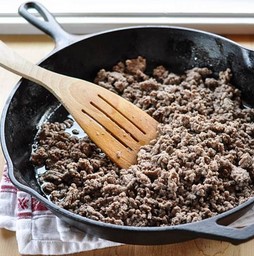
Next, you’ll want to fry your meat, and then drain off as much grease as you can. The fat can go rancid in the jar.

Now, get your clean canning jars and begin to pack them with your ground meat. You’ll want to pack it as tight as you can using the end of a wooden spoon. You can fit about 1 1/2 lbs in a quart size jar.

After your jars are packed tight, pour boiling water over meat in jar. Use a butter knife down each side to remove any air bubbles.

Wipe the rim of your jars and put on your lids and rings, tighten the rings as tight as you can.

Fill your pressure canner 1/4 of the way full with water.

Put jars in canner and latch lid.

Once the canner starts to let out steam, let steam escape for 10 minutes.

Then put your canner weight on. Let your pressure build to 15psi.

Keep your pressure at 10psi for 90 minutes. Set your timer, but DO NOT LEAVE CANNER UNATTENDED!
You may need to adjust your temperature up or down to keep your psi at 15.

Finishing Up

Once your timer goes off, shut off your heat. Let the canner sit and cool, until your pressure gauge reads 0.

DO NOT TAKE OF LID BEFORE CANNER PSI REACHES ZERO SEVERE BURNS WILL OCCUR!!!

When your gauge reads 0psi, removed your lid. MAKE SURE YOU TURN IT AWAY FROM YOU AS YOU REMOVE IT OR YOU WILL GET STEAM BURNT!

Remove jars from canner, with a jar lifter, and place on a towel on the counter. Allow jars to cool overnight.

In the morning, check each jar to make sure they sealed before storing. (Gently tap the lid and listen to the sound, if one sounds hollow and the top clicks when pushed; its not sealed) if they are sealed remove rings and store the jars.

If a jar did not seal, it is not spoiled. You can put it in the fridge and use to that day. Make sure to boil it for at least five minutes.

THIS FINISHED PRODUCT! Use sausage in biscuits and gravy, spaghetti, lasagna, on pizza, in any recipe that calls for ground meat or sausage.