Growing, Harvesting, & Preserving Your Own Tomatoes

Introduction

Who doesn’t enjoy eating a fresh tomato? When you grow them yourself, they are so much better than the hothouse ones from the grocery.

Tomatoes can be a hard thing to get to take off at first. But when you have fresh tomatoes of salsa in the summer or tomato juice to make chili in the winter, it is so rewarding! It is also a good time to remember to give Thanks to Yehovah for all things he has given you.

Planting

To start your tomatoes you will want to start them in late winter, in either your potting shed or greenhouse. If you don’t have either of those things, you can always start them in your house.

First, begin by having your trays and potting soil on hand. Really broke down compost makes good potting soil!

Fill your tray(s) with your soil and push it down until it is about 3/4” from the top of the tray. Water the soil lightly. This will make the seed not go down too deep when you water again after you have planted the seeds. Why does that matter? Because if the seeds go down too far, the seed will not sprout; it will rot.

Now, put 1 seed in each cell and cover them by topping off each cell with more soil. Make sure to keep the soil moist by watering them. Keep them as much in direct sunlight as possible. Within 7-14 days, they should begin to sprout, depending on how much sunlight they are able to get. Remember, if you are planting more than one variety, to put markers so you know which varieties are which.

Note: At this point, they may become spindly. If they are still short and just a little spindly, they should end up being fine. If they are VERY spindly, so that they are weak and snapping, don’t worry! They can still be saved.

Very carefully, pull them up out of their cell with your fingers. Do it one sprout at a time so that you don’t end up with a mess. Fill your cell with dirt and make a hole in the dirt by pressing down your finger about an inch and a quarter. Now put your spindly little sprout down into the hole and fill the little hole back in. Your objective will be to have the spindly part covered in dirt up to the leaves.

Taking Care of the Young Plants

Keep a close eye on your sprouts, and make sure that they maintain a good green color. You do not want them to begin turning a pale yellow color. If they start to turn a pale yellow color you need to act quickly so that you do not lose your plants. Put broke down compost around them to ‘feed’ them, because they turn pale from not getting the nutrients they need. This should turn them around pretty quickly.

If it starts to warm outside, into the 50F range or above, you need to bring them outside in the daytime as much as possible to make sure they get as much sunlight as possible. But be sure to bring them in when it is cold, you don’t want them getting frosted on!

Transplanting

About 35-40 days after planting, your plants should be too big for their cells. It is time to transplant them.

We transplant ours from their cells right into 9 oz cups. You should be able to find this size cup at pretty much any store. Either plastic or thick paper work well. You want to make a little hole in the bottom of each cup to make sure the excess water can drain out.

Fill your cups a little over 1/4 way full of potting soil/compost and put your plant in. Then fill the rest of the cup with soil until it is all the way up to the leaves. When finished, water them. Keep in mind not to let your plants be in too cold of temperatures or get frosted on!

Planting Outside

The timing on planting outside is all going to depend on where you live. Look up the last frost date for your area. Sometimes it will frost after the ‘last frost date’ but it will give you a pretty good idea of when it is safe to move your plants outside for good. We usually plant our tomatoes outside within the week after the last frost date for our area.

This gives us a pretty good chance of having some really early tomatoes.

To plant, just dig a hole in the ground, put compost, water, and your plant all in the hole and cover with dirt. We plant ours between about 4 rows of corn. This helps keep them shaded and prevent sun-scalding from happening to the tomatoes when the fruit begins to come on them in a few months.

Keep your plants moist and watered until they are established.

If they start looking pale, or you don’t see them beginning to bloom, or even not too many blooms, compost your plants. You should also put a small handful of Epsom salt in a gallon of water and put it on your plants. This brings up the magnesium and help your plant have more (and more productive) blooms.

When your plants get bigger, you may notice they start to cover your walkways and take over the garden. It’s time to tie them up!

Set posts on each end and in the center of your rows as close as they need to be to keep a straight line and not have the plants sag. Run your string post to post, tying up your plants as you go. The end result should look something like this:
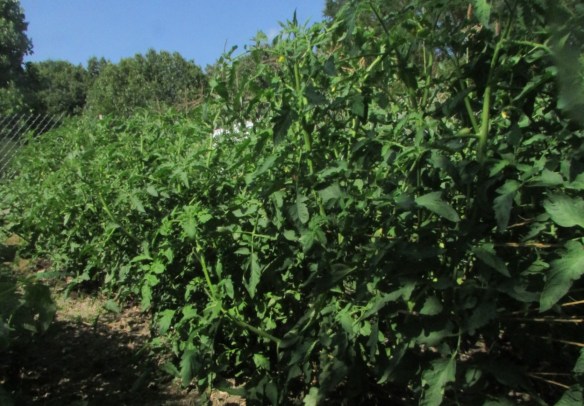
Keeping your plants tied up will help to prevent blight. More tomato related issues, and how to deal with them , to come in another post soon!

Harvesting

This is one of the things we all look forward to every year! Who doesn’t look forward to eating a fresh tomato? And harvesting tomatoes is simple; all you have to do is just pick them off your plants!

Be sure to give thanks to our Heavenly Father for his wonderful blessings. And remember to bless others with the first-fruits of all your increase! (Prov. 3:9)

Preserving (Canning) Tomato Juice

There are many different ways to preserve tomatoes. But we are going to focus on canning them as juice today.

Juice

Wash your tomatoes and cut them in quarters. Put a pot on to cook down and keep it stirred. If they are not already juicy enough and, even when stirred, seem to want to burn easily, you can add a little water if need be.

When your tomatoes have cooked down (you’ll be able to tell as they will just seem like ‘mush’), run them through your food mill, the same as you do applesauce. (see post here)

When you have finished this process, put your jars into the oven on ‘warm’ setting, or the lowest your stove will go (most go down to 170F and this is suitable)

We are going to do what you call the “water bath” method.

Fill your canner half full of water and turn your burner on.

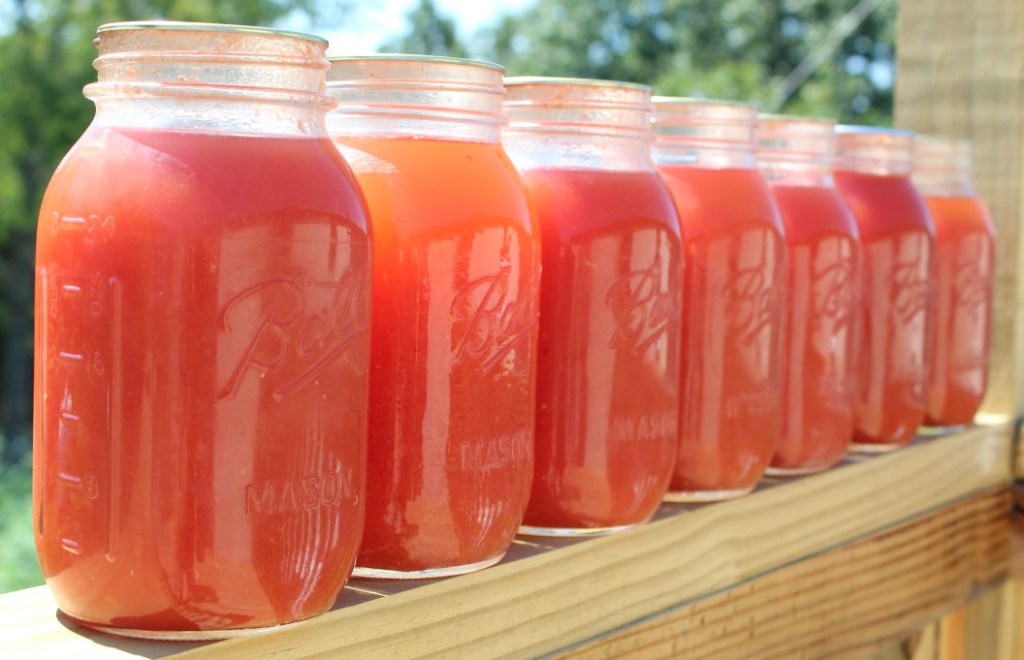
Now you should have hot juice, hot jars, and a hot canner ready to go. Ladle that hot juice into your jars and wipe the rims clean. Then, place your lids on your jars and screw on the rings tightly. Place in your canner and put on the lid on, but do NOT lock it on. When your water starts to boil, set your timer for 35 minutes.

The next step is taking them out of the water. Start by placing a towel on your countertop and then put your jars on top of the towel, using a jar lifter to keep from getting burnt. A jar lifter is pictured below:

Let your jars sit on your counter for 12 hours. Check seals and store.

The reason you want to check the seals is to make sure they are all secure before you store them.

You check the seals by tapping the jar lids with one finger. As you tap them, listen for a jar that sounds different than the rest of them. It will usually make a hollow sound.

If you find a jar that hasn’t sealed, put it in the fridge and use it soon. If you are planning more canning, you can try to can it again. Make sure there are no nicks in the top of jar and a good lid on it.
Growing Your Own Lettuce

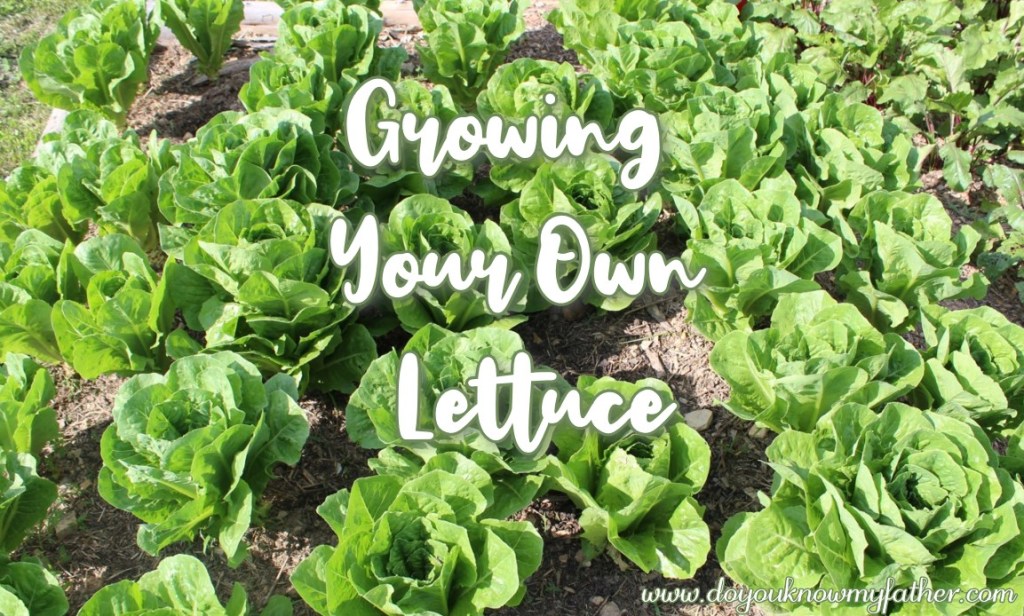
Put potting soil or compost in a sour cream container that has holes in the bottom. Water the soil and then sprinkle your lettuce seeds over top. Sprinkle soil about 1/8” over the seeds. Water daily, making sure you don’t water too much or the seeds will wash down and won’t sprout.

Once your lettuce is 1-2” tall, transplant them individually into a small cell tray. Once they’ve reached 4-5” tall, it’s time to plant them outside.

Plant them about 8” apart in rows. We put manure and water in the holes before planting. Water everyday until they’re established.

We lightly mulch around ours to keep mud from splattering on the lettuce when it rains.

Our Beets and Lettuce growing side by side in our garden

Once they are ready to pick, pick only the outside leaves working from the bottom up, leaving the smaller ones in the middle. Remove any yellow leaves and put them on the compost pile, or feed it to your sheep or goats.

When you notice your plants starting to grow slower, you will need to put manure around them to help feed the soil.

Doing it this way, you will get more lettuce from your plants, the lettuce stays clean and they will produce longer.

“And God said, Behold, I have given you every herb bearing seed, which is upon the face of all the earth, and every tree, in the which is the fruit of a tree yielding seed; to you it shall be for meat.”

Gen. 1:29

Zucchini: Planting, Nourishing, Harvesting, & Preserving

Zucchini is one of the easier vegetables to grow, making it very rewarding. If you can take keep the squash bugs away, you can get a lot of zucchini from just a couple plants!

Planting

You want to make sure you get heirloom seeds. We like the Black Beauty variety. We start zucchini in the spring, and then again in the fall. First you will want to make a hill about 6” tall and 1” wide. Then, put two seeds into each hole, 2” apart and push down a half inch. Cover with manure or compost, and water well.

Nourishing

When your plants look like the above photo, it will be time to feed them again. Put 3 TBSP of kelp around the base of each plant, then add some more compost or manure. Continue to water as needed.

If, as your plants grow and start to bloom, you see only male and no female blooms, you won’t get many zucchini without doing something about this.You need males to pollinate the females. The female plants are the ones that will turn into a zucchini. If you do not know the difference in male and female blooms, use the photo below as a guide.

If we have this problem, here is what we do to help.

De-solve 2 TBSP of Epsom salt in a gallon of water and pour it around the base of the plant. Do this for each plant that you are having the problem with.

Harvesting

You can harvest your zucchini whatever size you like them. To harvest, all you have to do is grab the fruit and twist. If you like them small, make sure you keep an eye on them. They get big very quickly! The bigger they get, the more spongy they will be, and are less tasty when they are spongy.

If you are wanting to save seed from them, let one get as big as it will. Sometimes they will turn an orange-ish color once they are big. This does not mean you can’t save seed from them. They are still good for seed.

When you harvest, remember to pray who to give your first fruits to!

Honour Yehovah with thy substance, And with the firstfruits of all thine increase: So shall thy barns be filled with plenty, And thy presses shall burst out with new wine.

Proverbs 3:9-10

Saving Seed

When you pick the one you have let grow and go to seed, pick it and cut it open. Scoop out the seeds with a spoon, and lay the seeds out to dry on a tray for 2-3 days. Then, store in a jar with an airtight lid.

Preserving

The best way to preserve your zucchini is to either freeze or can it.

To freeze the zucchini, first you need to shred it. We have not had good success with freezing slices. When you have finished shredding the zucchini, squeeze out the juice/water. Put in a Ziploc bag and freeze.

To can, we use the following recipe:

Want a way to use your shredded zucchini? We enjoy making Zucchini bread, too! You can even use the above recipe for Pineapple Zucchini in place of the regular shredded zucchini the recipe calls for. We love using the recipes from America’s Test Kitchen, and this is one of them.

Growing Onions

It is always rewarding, and in our opinion better tasting, when you grow food yourself on your own land. You know where it came from, what you put in to it, and each step in between.

“Now he that planteth and he that watereth are one: and every man shall receive his own reward according to his own labour.”

1 Cor. 3:8

Getting Your Onion Sets

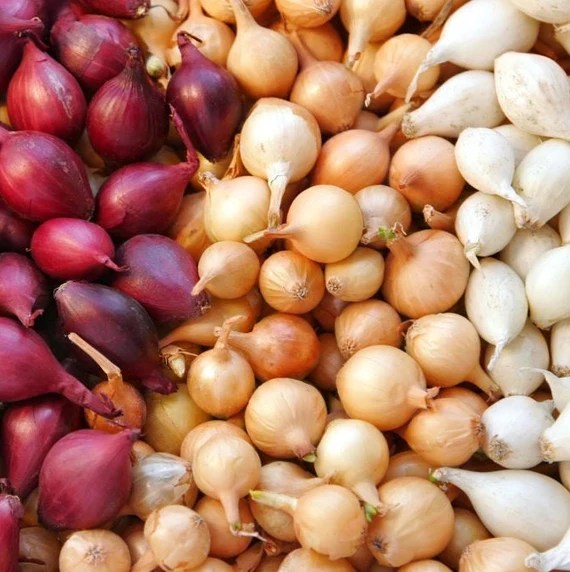
You should be able to find onion sets at most local farm stores. You will usually find yellows, reds, and white. In our experience, the reds (AKA purple) store the worst, yellows the best, and whites in the middle. We usually plant three of the bags that the farm store has. We have a good time each year playing ‘How many are in the bag’ as a family!

Planting

Early Spring is the time to plant your onions. We prefer to plant our onions on little hills. We found that planting them in little ditches makes them hold the moisture in. In our experience, this causes the onions to rot and not store well.

So, with a hoe, make small hills, about 6 inches tall. Once you have finished, push your onions one by one into the top of the hill, leaving only the stem sticking out of the ground. You want to place them about 4 inches apart from each other, so they have room to get good sized.

Nourishing the Plants

We like to put grass clippings (from the yard, not hay necessarily) in between our onion rows. We add another layer every couple of weeks. This helps to add nitrogen to the soil for the onions, as well as keeping in the right amount of moisture for the onions as they grow. This is very important when the heat of summer comes. The grass clippings also help a lot in keeping the weeds down in the onion patch. If you start to see buds come onto the tops of your onions, clip them off if you do not want them to go to seed. If they go to seed, the onion itself will not be good for eating. But if you want to keep seed, you can let a few go ‘bolt’ and there will be seeds for you at harvest time.

Harvesting

When the tops of your onions bend over (die), it is time to harvest! The onions will not continue to grow after this happens.

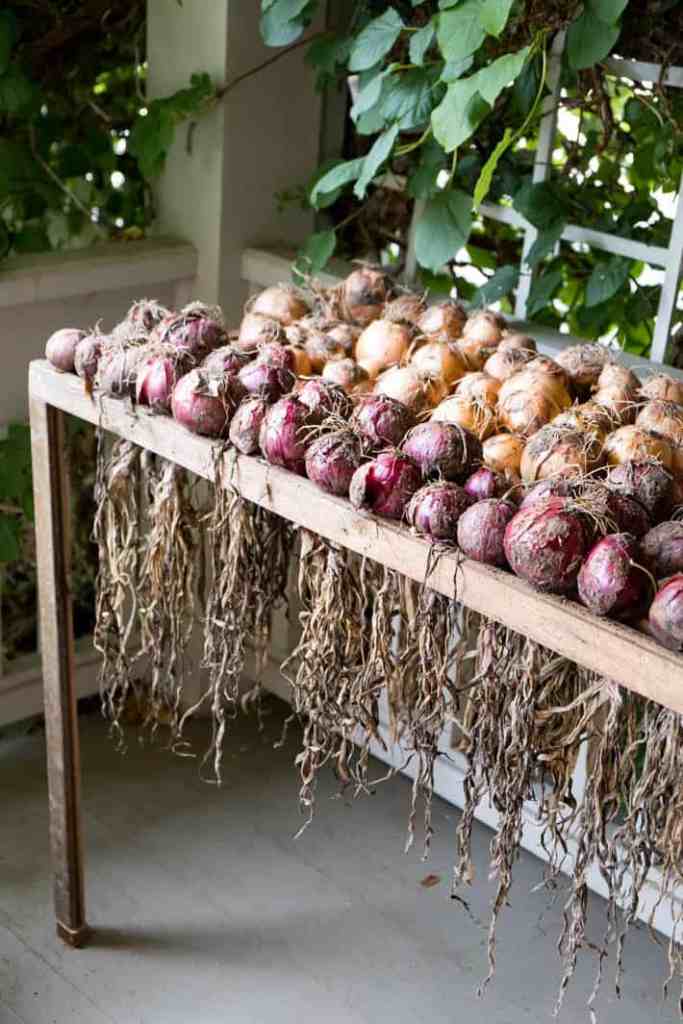
To harvest your onions, all you have to do is pull them out of the ground and lay them out to dry. The below idea will help them to dry out as fast as possible. Make sure you have them under a roof, out of the weather. You don’t want them to have any moisture in them when you store them, or they will rot, regardless of the color.

If you decide to lay them on a flat table, you will need to be flipping them every few days so they will continue to dry and not just send the moisture deeper into the onion.

Pulling your onions and seeing how much they have grown is a VERY rewarding time, and it is a great time to Praise Yehovah for your blessings and give him thanks!

Storing your Onions

When most of the tops of your onions are brown and there is no moisture left in it (rather than being bendy, the tops will be brittle) it is time to store them.

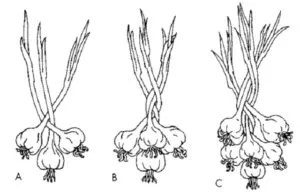
We like to braid our onions, the same way we do with our garlic. See below, and also our Garlic post.

When you have finished braiding your onions tops, hang them in a cool, dark, dry place.

I hope that this encourages you to grow your own onions this year! May Yehovah bless you this growing season and in the coming ones!

How To: Start a Southern Magnolia from Seed

And God saw every thing that he had made, and, behold, it was very good.

Gen. 1:31

When we moved to our new farm, there was a beautiful evergreen Southern Magnolia tree in our new front yard. We liked it so much (and so did our goats; they love to eat it’s leaves, which are high in Vitamin C and antioxidants!) that the little ones decided to try and grow a few more. Below is a post written by one of them, on how they went about getting their new ones to grow, from the seed of our tree.

To get started, in the fall, you will see little red seeds in seed pods, like the one in the center picture above. Collect the biggest ones when they start to fall out of the pods. Let your seeds dry for a few weeks.

When your seeds have dried, get your pot(s) that you want to plant in.

Fill your pot(s) half way full of dirt, and the other half with manure until it is pretty much full.

Put your seeds into the dirt/manure about 2” deep. If you plan to plant more than one, you can plant them in the same pot in the beginning about 2” apart. Once you have planted them, water them lightly.

Continue to water once daily. Find the balance of keeping them moist; not too wet and not too dry. You don’t want it muddy, you want it damp. If it is too dry, the dirt will be cracked and crumbly. If you get your soil too wet, you will rot out your seeds before they can start to grow.

In about 3 weeks, your plants will start to sprout. Keep up with the watering, and once they are about 8” tall, transplant them into their own individual pots. Let them get between 1-2′ before planting them into your yard.

For ye shall go out with joy, and be led forth with peace: the mountains and the hills shall break forth before you into singing, and all the trees of the field shall clap their hands.

Is. 55:12-13

Growing Your Own Potatoes

Potatoes are one of our favorite things to grow. They aren’t the easiest thing to grow, but the harvest is a very rewarding time. And like most things, homegrown potatoes taste the best!

Picking Out Your Seed Potatoes

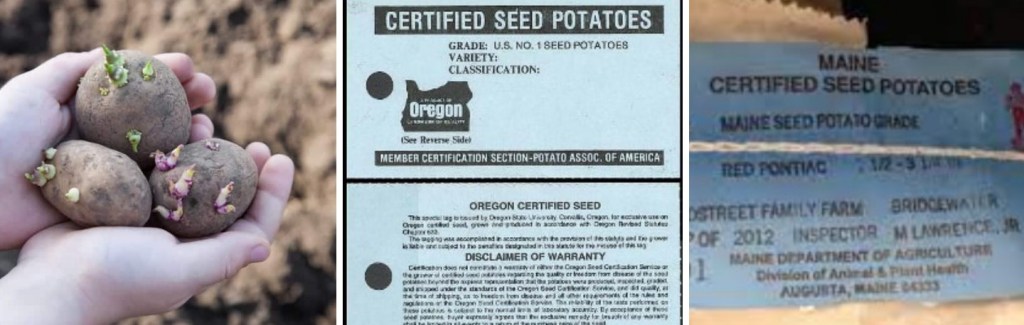
First you will need to buy your seed potatoes. Most local farm and hardware stores begin to carry them in the late winter and early spring. A good seed potato will have little sprouts coming out of it, also called ‘eyes’. They are sometimes a little squishy, but this is okay as they will just end up rotting in the ground. You want to look for a light blue tag on your potato bag, to make sure it hasn’t been treated with chemicals to keep them from sprouting. (see below)

You will want to get enough seed potatoes that you will have enough to eat on until next years harvest, and some left over to plant. Then you will not need to get seed potatoes next year!

Planting

You will want to plant your potatoes in the spring. You need to know the frost dates for your area, to get an idea of when to plant them.You can plant them about two weeks before the last frost date, as they won’t be above ground until after the last frost is expected. If you do it earlier and they start to pop out of the ground before the frost, the frost will kill them. It can be hard to wait, when you get some warm days and want to plant, but it is worth waiting so you don’t have as much chance of loss.

When you are ready to plant, you just need your potatoes and a good hoe. With your hoe, make a hole big enough to put your potato in. Then, put a whole potato, or a couple of little potatoes, in each of the holes you made, the ‘eyes’ (or side with the most eyes) pointing up. The more potatoes you put in, the more potatoes you will end up with when harvest time comes!

But this I say, He which soweth sparingly shall reap also sparingly; and he which soweth bountifully shall reap also bountifully.

2 Cor. 9:6

When you are finished putting all your potatoes in the holes, sprinkle them with sulfur. We do this for a better harvest, as well as to keep bugs away. Sulfur helps them with nitrogen uptake, amino acid formation, and vitamin and mineral synthesis.

Add some water to your hole.If your soil is poor, like ours is, it is a good idea to add some manure into the hole as well.

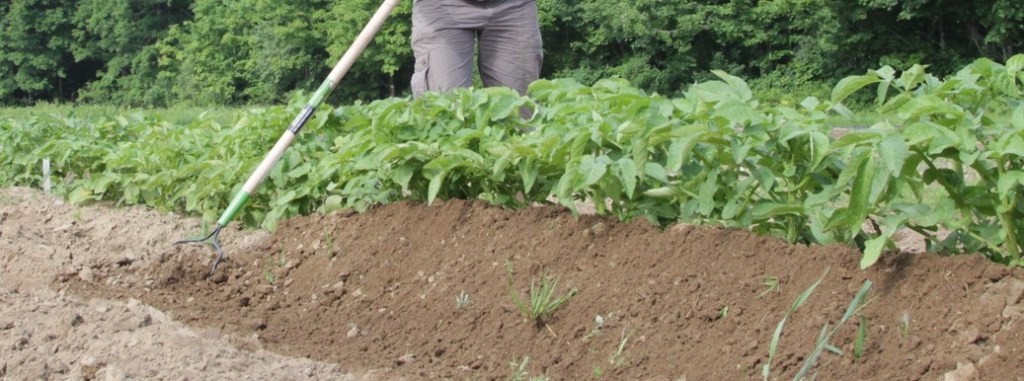
After you have done these things, you want to hill your potatoes. You can do this with a hoe or a garden rake. Manure the hill again when finished. In a month or so, you will see them start poking out of the ground!

Example of potato ‘hilling’

Nourishing the Plants

In the spring and early summer, you will probably not need to water if you get sufficient rainfall. Keep an eye on the moisture of your soil, and that it doesn’t get too dry.

When your plants are 3 months old, or 3-4′ tall, they should start to bloom. If they don’t they might need more nitrogen, or they might be low in magnesium.

If they need more nitrogen, add manure. If they are low in magnesium, spritzing them with Epsom salt water will help them begin to bloom. You will add 1 TBSP per gallon of water.

If they still don’t bloom, it DOES NOT mean there are not any potatoes underground. We had a year where there were only a handful of blooms in our whole patch, and we still had a good harvest.

Around this same time, you will want to hill your potatoes a second time.

Harvesting

When the plants are laid over, dry, and dead, this means it is time to harvest!

Do not dig your potatoes on a wet day, wait for a day when the soil is dry.

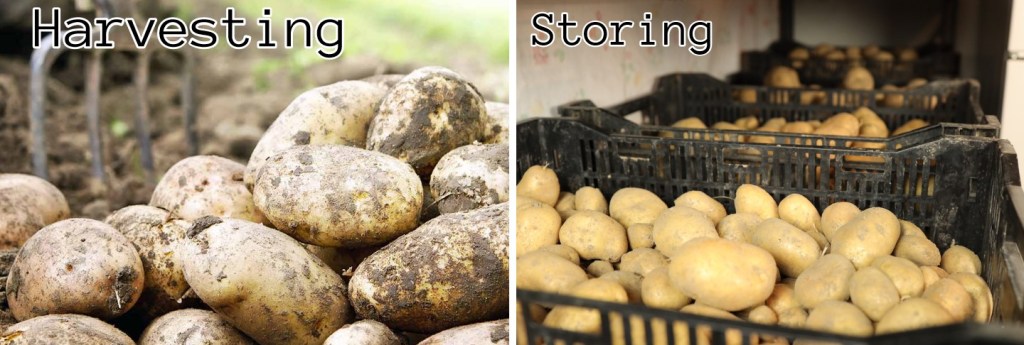
Take a potato fork and dig into your hills. Be very careful. If you aren’t careful, you could stab into your potatoes. It doesn’t ruin them, but you can’t store them if they are punctured. They will need to be eaten or preserved another way quickly so they don’t rot.

Pick up your potatoes, and put them carefully into crates, being careful not to bruise or scrape them if possible. Sort out the ones that will keep longer from the ones that you need to use up first. (These will include the ones you may have accidentally forked, have bug holes, etc). DO NOT wash your potatoes until you are ready to use them, as this will also cause them to rot quickly.

Honour Yehovah with thy substance, And with the firstfruits of all thine increase: So shall thy barns be filled with plenty, And thy presses shall burst out with new wine.

Pr. 3:9-10

We follow this scripture, pray, and give the firstfruits of our increase (the harvest) to who God puts on our hearts.

Enjoy your harvest!

How to Make Your Own Sauerkraut at Home

Whether therefore ye eat, or drink, or whatsoever ye do, do all to the glory of God.

1 Cor. 10:31

When you make your own sauerkraut at home, it contains many more health promoting benefits. You don’t want to pasteurize it and kill all the good bacteria in it.

8 reasons to eat more sauerkraut: (1)

1. Enhanced nutrient availability 

2. Reduced gas production 

3. Increase in acetylcholine 

4. Increase in lactic acid 

5. Spike in vitamin C

6. Spike in vitamin K2

7. Immune support 

8. Spike vitamin U

What you’ll need:

3 heads of cabbage

5 TBSP salt

Water

Crock

Cut your cabbage in half, then quarter. Take out the core with your knife.

Slice your cabbage VERY thin. (Think about the thinness of sauerkraut.)

There are a few different ways to slice/shred it.

  1. Take a big knife, and shred/slice very thin.
  2. Shred the cabbage with a cheese grater
  3. Put your shredding blade on your food processor and run it through.

After you have your cabbage shredded thin, put it in your crock. Add salt.

Now, punch down your cabbage with your fists, (you can also use a tool made for this, or a thick wooden spoon) until it becomes softer and you get the juices to come out.

The juice should end up covering the cabbage. But, if for some reason, your cabbage is soft and just not juicy enough to have juice covering itself; add water to finish covering it. You want there to be an inch or so of water/juice over the top of the shredded cabbage.

Take a plate that will fit inside of your crock and place it upside-down inside of your crock. Put a jar full of water (with a lid, of course) over the top. You want this to wait down and put pressure on the plate. Cover entire crock with a towel, and let sit in a cool dark place for 4-7 days. Some crocks come with lids, these will work just as well. You will be able to tell when it is ready when it smells/tastes like Sauerkraut!

Put your sauerkraut in glass jars, and store in the fridge. It will keep in the fridge for 4-6 months.

Making & Processing Pear Sauce and Pear Butter

Fall is busy! It is when we wrap up harvesting for the year. It is a time to be thankful for what we have been blessed with in the past year, and preserving some of it for the winter.

Giving thanks always for all things unto God and the Father in the name of our Master Yehoshua Messiah.

Eph. 5:20

You start by washing your pears.

Cut them into quarters, and put into a large stockpot; continue until your out of pears, or your stockpot is full. (The same process as you would with applesauce.)

Put your pot on the stove with 1-2 qts. of water in it. Pears are usually a lot juicier than apples, so you don’t have to put near as much water as you do when processing apples.

While the pears are cooking down, fill your canner half full with water and get it on a burner on your stove. Turn on low heat. Also, go ahead and get your jars warming in your oven on ‘warm’ or the lowest setting it will go to.

After the pears are cooked down, while it is still hot, run all your hot, mushy pears through your food mill. The result will be pear sauce!

Pear Butter (skip this part if you just want to can your sauce)

To fill one canner with quart jars:

28 cups pear sauce (or 7 quart jars)

4 cups sugar

2 tsp cinnamon

1/2 tsp ground cloves

Put into oven or roaster pan, and cook at 350F and cook it down for 9-12 hours. You want it to be thick so that when you stir it with a spoon, it has the consistency of jelly. You will have to watch your particular batch to see how long that takes.

Canning Preparation:

When everything is hot/warm, you are ready for the next step.

Fill your hot jars with the hot pear sauce, leaving an inch of head space in the top of your jar. Put a butter knife down the insides of your jar (between the glass and the sauce) to let out any air bubbles in the jar/sauce. Wipe your rims clean with a rag or paper towel to remove any sauce. If you don’t do this, it can prevent your lids from sealing tightly to your jar.

Put on your pre-warmed lids and screw on your rings tightly. Put your jars into your warm water in your canner, with a jar lifter, pictured below.

Water Bathing

After all the jars are in the canner, you want your water to be one inch above the jars for water bathing. Turn on high. When the water starts to boil, set your timer for 20 minutes for quart jars or 15 minutes for pint jars. Turn stove to medium heat. When timer goes off, turn heat off, and let canner sit for 5 minutes. Then, carefully take out your jars with a jar lifter and set them on a towel on your countertop to cool. If your bands are loose, do not tighten them.

Cool for 12 hours. Check seals and store.

The reason you want to check the seals is to make sure they are all secure before you store them.

You check the seals by tapping the jar lids with one finger. As you tap them, listen for a jar that sounds different than the rest of them. It will usually make a hollow sound.

If you find a jar that hasn’t sealed, put it in the fridge and use it soon. If you are planning more canning, you can try to can it again. Make sure there are no nicks in the top of jar and a good lid on it.

In every thing give thanks: for this is the will of God in Messiah Yehoshua concerning you.

1 Thes. 5:18

Planting, Growing, & Preserving Your Own Garlic

When you plant garlic, you plant the garlic cloves.

You want to start by breaking your cloves apart from each other. Do not pull the ‘paper’ off of your cloves. Make sure to pick your biggest and best looking cloves, not the inside ones that are small and clumped together. Otherwise, you won’t have big bulbs when you harvest them midsummer.

He which soweth sparingly shall reap also sparingly; and he which soweth bountifully shall reap also bountifully.

2 Cor. 9:6

Planting

Garlic grows best when planted in the mid fall. First, work up your soil where you want to plant it well, and mix in plenty of compost.

In a straight line, you start planting by taking the garlic cloves, with the stem pointing up in the air and roots pointing downward, and push it into the soil. Leave only the stem sticking up above the soil.

Keep repeating this process, making sure to plant the cloves 4 inches or so apart from each other.

When you have finished planting them, you will want to cover them with straw or old hay (and keep your chickens out of the beds!) Wet down the straw or old hay so that it doesn’t just blow away.

Growing

In the Spring, they will start to grow some tops. They will continually get taller, making bigger and bigger bulbs throughout the spring and early summer.

Garlic does not need as much water as other plants. If you water 2x per week, they will do well (remember to minus the rain you receive).

Harvesting

Note: Before you harvest, it is easier to pull them up if you wet your soil a day prior to harvesting. If you don’t want to do that, you can always use a shovel; but remember to dig them carefully!

When the tops of the garlic are laid over and dry, it is ready to be harvested.

This should be mid to late summer.

Preservation/Curing

After you have pulled/dug your garlic, lay them to dry on a table outside in the shade. Keep them there (unless it rains; then move them into a barn, garage, etc) until the stems are dry and brittle.

How do you know when the stems are dry? When you can break them easily, and they feel brittle like straw or old hay.

Why do they have to be dry?

You want them to be dry, so that when you braid your stems together, they do not mold, wasting your time and harvest.

Storing/ Hanging

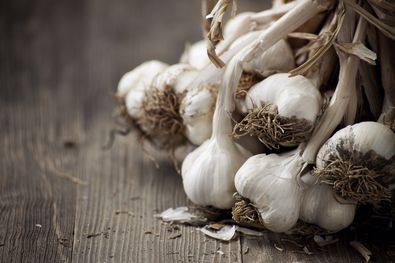
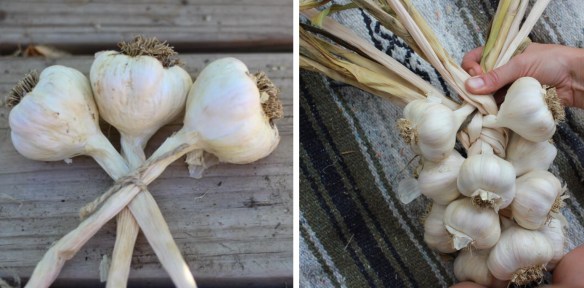
We like to store our garlic by braiding the stems together and hanging them in the coolest, driest place possible.

To begin braiding, take 3 garlic (we leave our stems long and intact) and begin braiding them like you would someones hair, adding more as you go, like in a french style braid.

Take some sort of twine, yarn, or whatever will do the job and tie the end of your braid. Knot, and make a loop to hang it from. Hang your loop on a nail or something in a cool dry place. If some of your bulbs break off, it’s alright. You can store them in an onion bag or just use them first.

Don’t forget to save some back to replant in the fall!

May Yehovah bless you as you grow some of your own garlic for the first time!

Processing Applesauce & Apple Butter

Start by washing your apples. Once that is done, cut into quarters; skins, seeds and all.

Put these quarters into a large stockpot. If your apples are really dry, you need to add about a gallon of water to a very large stockpot full. If your apples are very juicy, you need little to no water. You will have to gauge it by the juiciness of your apples, so that they do not burn.

Put your stockpot on the stove, start, and stir often; about every few minutes.

After the apples are cooked down, while it is still hot, run all your hot, mushy apples through your food mill. The result will be applesauce!

Two Types of Food mills (we prefer the one pictured on the right)

Apple Butter (skip this part if you just want to can your sauce)

To fill one canner with quart jars:

28 cups applesauce (or 7 quart jars)

4 cups sugar

2 tsp cinnamon

1/2 tsp ground cloves

Put into oven or roaster pan, and cook at 350F and cook it down for 5-9 hours. You want it to be thick so that when you stir it with a spoon, it has the consistency of jelly. You will have to watch your particular batch to see how long that takes.

Prepping for canning

Fill your canner half way with water, and turn on. Put your empty jars in your oven on ‘warm’. If your oven doesn’t have a ‘warm’ setting, just put it on the lowest setting it has.

When everything is hot/warm, you are ready for the next step.

Fill your hot jars with the hot applesauce, leaving an inch of head space in the top of your jar. Put a butter knife down the insides of your jar (between the glass and the sauce) to let out any air bubbles in the jar/sauce. Wipe your rims clean with a rag or paper towel to remove any sauce. If you don’t do this, it can prevent your lids from sealing tightly to your jar.

Put on your pre-warmed lids and screw on your rings tightly. Put your jars into your warm water in your canner, with a jar lifter, pictured below.

Water Bathing

After all the jars are in the canner, you want your water to be one inch above the jars for water bathing. Turn on high. When the water starts to boil, set your timer for 20 minutes for quart jars or 15 minutes for pint jars. Turn stove to medium heat. When timer goes off, turn heat off, and let canner sit for 5 minutes. Then, carefully take out your jars with a jar lifter and set them on a towel on your countertop to cool. If your bands are loose, do not tighten them.

Cool for 12 hours. Check seals and store.

The reason you want to check the seals is to make sure they are all secure before you store them.

You check the seals by tapping the jar lids with one finger. As you tap them, listen for a jar that sounds different than the rest of them. It will usually make a hollow sound.

If you find a jar that hasn’t sealed, put it in the fridge and use it soon. If you are planning more canning, you can try to can it again. Make sure there are no nicks in the top of jar and a good lid on it.