Making Homemade Hummus

When you make your own hummus, it just tastes better!
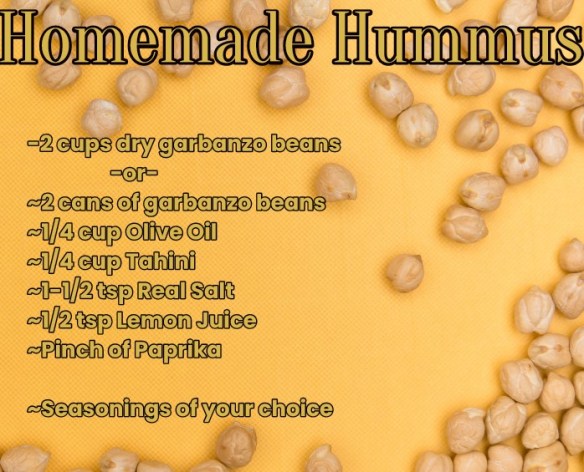
For starters, you need garbanzo beans. They are the base ingredient in hummus.

If you are starting with dry beans, you need to measure out 2 cups. Put them in a bowl, and make sure there is room in the bowl for them to expand. Cover them with water, and let sit for 24-48hrs. If you let them sit for 48hrs, you want to drain off the water and refill it after the first 24hrs. (If you buy canned garbanzo beans, skip this process, and just use two cans, as they are precooked)

Once they have finished the soak, drain and rinse them. Put them on to boil in a stock pot until they are soft. This usually takes about 3-3 1/2hrs.

After they are done boiling, rinse them again. If you like a more creamy textured hummus, take of the little peel around each bean. This is pretty easy, but it is tedious and does take awhile. If you don’t mind a nuttier texture, you can leave the peels on.

After you are done, put your beans in your food processor, and process them until crumbly in texture. While your processor is running, add in the water, olive oil, and tahini. (We like the tahini imported from Israel, Simple Truth Organic) Process until it has that hummus texture.

Pour your hummus into a bowl, and add in the salt, and lemon juice; stir until well mixed.

Top with paprika, and any other seasonings of your choice. You can also add more olive oil to the top if you like.

Enjoy!

Planting, Growing, & Preserving Your Own Garlic

When you plant garlic, you plant the garlic cloves.

You want to start by breaking your cloves apart from each other. Do not pull the ‘paper’ off of your cloves. Make sure to pick your biggest and best looking cloves, not the inside ones that are small and clumped together. Otherwise, you won’t have big bulbs when you harvest them midsummer.

He which soweth sparingly shall reap also sparingly; and he which soweth bountifully shall reap also bountifully.

2 Cor. 9:6

Planting

Garlic grows best when planted in the mid fall. First, work up your soil where you want to plant it well, and mix in plenty of compost.

In a straight line, you start planting by taking the garlic cloves, with the stem pointing up in the air and roots pointing downward, and push it into the soil. Leave only the stem sticking up above the soil.

Keep repeating this process, making sure to plant the cloves 4 inches or so apart from each other.

When you have finished planting them, you will want to cover them with straw or old hay (and keep your chickens out of the beds!) Wet down the straw or old hay so that it doesn’t just blow away.

Growing

In the Spring, they will start to grow some tops. They will continually get taller, making bigger and bigger bulbs throughout the spring and early summer.

Garlic does not need as much water as other plants. If you water 2x per week, they will do well (remember to minus the rain you receive).

Harvesting

Note: Before you harvest, it is easier to pull them up if you wet your soil a day prior to harvesting. If you don’t want to do that, you can always use a shovel; but remember to dig them carefully!

When the tops of the garlic are laid over and dry, it is ready to be harvested.

This should be mid to late summer.

Preservation/Curing

After you have pulled/dug your garlic, lay them to dry on a table outside in the shade. Keep them there (unless it rains; then move them into a barn, garage, etc) until the stems are dry and brittle.

How do you know when the stems are dry? When you can break them easily, and they feel brittle like straw or old hay.

Why do they have to be dry?

You want them to be dry, so that when you braid your stems together, they do not mold, wasting your time and harvest.

Storing/ Hanging

We like to store our garlic by braiding the stems together and hanging them in the coolest, driest place possible.

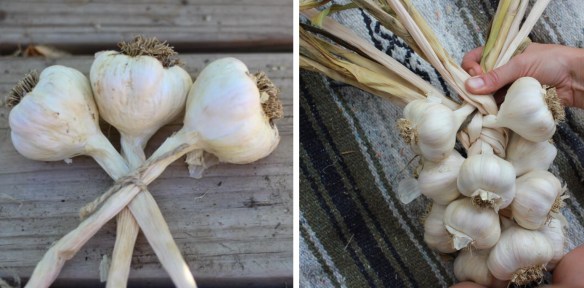
To begin braiding, take 3 garlic (we leave our stems long and intact) and begin braiding them like you would someones hair, adding more as you go, like in a french style braid.

Take some sort of twine, yarn, or whatever will do the job and tie the end of your braid. Knot, and make a loop to hang it from. Hang your loop on a nail or something in a cool dry place. If some of your bulbs break off, it’s alright. You can store them in an onion bag or just use them first.

Don’t forget to save some back to replant in the fall!

May Yehovah bless you as you grow some of your own garlic for the first time!

Processing Applesauce & Apple Butter

Start by washing your apples. Once that is done, cut into quarters; skins, seeds and all.

Put these quarters into a large stockpot. If your apples are really dry, you need to add about a gallon of water to a very large stockpot full. If your apples are very juicy, you need little to no water. You will have to gauge it by the juiciness of your apples, so that they do not burn.

Put your stockpot on the stove, start, and stir often; about every few minutes.

After the apples are cooked down, while it is still hot, run all your hot, mushy apples through your food mill. The result will be applesauce!

Two Types of Food mills (we prefer the one pictured on the right)

Apple Butter (skip this part if you just want to can your sauce)

To fill one canner with quart jars:

28 cups applesauce (or 7 quart jars)

4 cups sugar

2 tsp cinnamon

1/2 tsp ground cloves

Put into oven or roaster pan, and cook at 350F and cook it down for 5-9 hours. You want it to be thick so that when you stir it with a spoon, it has the consistency of jelly. You will have to watch your particular batch to see how long that takes.

Prepping for canning

Fill your canner half way with water, and turn on. Put your empty jars in your oven on ‘warm’. If your oven doesn’t have a ‘warm’ setting, just put it on the lowest setting it has.

When everything is hot/warm, you are ready for the next step.

Fill your hot jars with the hot applesauce, leaving an inch of head space in the top of your jar. Put a butter knife down the insides of your jar (between the glass and the sauce) to let out any air bubbles in the jar/sauce. Wipe your rims clean with a rag or paper towel to remove any sauce. If you don’t do this, it can prevent your lids from sealing tightly to your jar.

Put on your pre-warmed lids and screw on your rings tightly. Put your jars into your warm water in your canner, with a jar lifter, pictured below.

Water Bathing

After all the jars are in the canner, you want your water to be one inch above the jars for water bathing. Turn on high. When the water starts to boil, set your timer for 20 minutes for quart jars or 15 minutes for pint jars. Turn stove to medium heat. When timer goes off, turn heat off, and let canner sit for 5 minutes. Then, carefully take out your jars with a jar lifter and set them on a towel on your countertop to cool. If your bands are loose, do not tighten them.

Cool for 12 hours. Check seals and store.

The reason you want to check the seals is to make sure they are all secure before you store them.

You check the seals by tapping the jar lids with one finger. As you tap them, listen for a jar that sounds different than the rest of them. It will usually make a hollow sound.

If you find a jar that hasn’t sealed, put it in the fridge and use it soon. If you are planning more canning, you can try to can it again. Make sure there are no nicks in the top of jar and a good lid on it.

Store Bought Clean and Kosher Bread

Although a store bought bread brand may not have a Kosher Symbol, it still may be clean.

Why? First, it has to do with the Rabbinical teaching of not eating meat and dairy at the same time. We are not following the Rabbi’s and Rabbinical Judaism.

We are following Yehovah and His Commandments.

Some bread contains dairy, so since you might eat meat at the same meal as bread, the Rabbi’s prohibit bread having dairy. They are concerned that someone might accidentally eat bread with dairy and also eat meat at the same meal.

If you see a Kosher Symbol on bread, you may also see the word Pareve. This word means that the food is prepared without meat and milk.

“And he took butter, and milk, and the calf which he had dressed, and set it before them; and he stood by them under the tree, and they did eat.” Genesis 8:18

The Father of our Faith, Abraham, when he was visited by Yehovah, made a feast with meat and dairy and they did eat. If it was good enough for The Father, it’s good enough for us!

So, if you eat clean, but not kosher, you still may be able to eat some store bought breads if they do not have a Kosher symbol.

Don’t know what Kosher symbols look like? Click here for a picture of common symbols.

However, there are some ingredient in store bought breads that are not clean.

These can include: Enzymes, such as Alpha-Amylase from hog pancreas , L-cysteine, from duck feather, hog hair, hooves, horns or human hair, or mono and diglycerides, which can come from pork fat.

If the bread contains mono and diglycerides, but has a Kosher symbol, means that they are not from a pork source.

Some store bought bread isn’t healthy even if it’s clean and kosher. A great alternative is to make your own homemade sourdough bread. See our recipe here.

Clean and Kosher Cheese

Our family had thought we were eating clean for a couple years. Then we learned that pork, shellfish, and other unclean animals are hidden in different kinds of foods and supplements.

Here we’ll discuss what we learned about cheese, but first we’ll discuss why we eat dairy and meat together i.e. cheeseburgers, lasagna, etc.

“Thou shalt not seethe a kid in his mother’s milk.” Ex.34:26

Jewish Rabbi’s say that this scripture means that you cannot eat meat and milk together. That is not what Yehovah is saying here.

Some cheese is not labeled “kosher”, for this reason.

He is telling us not to cook a kid (kid, lamb,or calf) in their mother’s milk, because the milk from their mother is what would give them life. It’s not that we can’t eat these two things together, but that it is cruel to cook a kid in what would be it’s life source, and Yehovah say’s not to do it. It is that simple.

“And he took butter, and milk, and the calf which he had dressed, and set it before them; and he stood by them under the tree, and they did eat.” Genesis 18:8

We can see where Abraham, the Father of our Faith, when he was visited by Yehovah, fed him both milk and meat at the same meal.

Although we eat milk and meat together, we are not going to invite someone over for supper who doesn’t and make them a cheeseburger. Then argue with them about why they won’t eat it. Because Scripture says:

But when ye sin so against the brethren, and wound their weak conscience, ye sin against Messiah Wherefore, if meat make my brother to offend, I will eat no flesh while the world standeth, lest I make my brother to offend. 1 Corinthains 8:12-13

OUR PRINTABLE PDF CHEESE LIST

This two page list will help you when you are grocery shopping. You can print if off to take it with you to the store. If a cheese is on our list, it is clean, kosher, or both.

There are some companies that use pork rennet as their enzymes, which would make them unclean. While other companies use lamb or calf rennet, so those cheeses would be clean,although not be labeled as kosher.

What is rennet? Rennet is the enzyme used to coagulate the milk (separate the curd from the whey), in order to make cheese from the curds. There are different kinds of rennet, some are animal derived and others are microbial-based (derived from mushrooms, mold or yeast).

Some companies use animal based enzymes and others microbial or vegetable based enzymes.

The link below is to a website that lists vegetarian cheeses, which would make them clean.

https://vegetatio.com/content/joyous-living-full-vegetarian-cheese-list

Another website listed below is a kosher certification company, where you can search different products, by brand name, to see if it is kosher.

https://oukosher.org/product-search/

Keep in mind things can change, so it is best to keep informed on what changes companies may be making.